
Blog
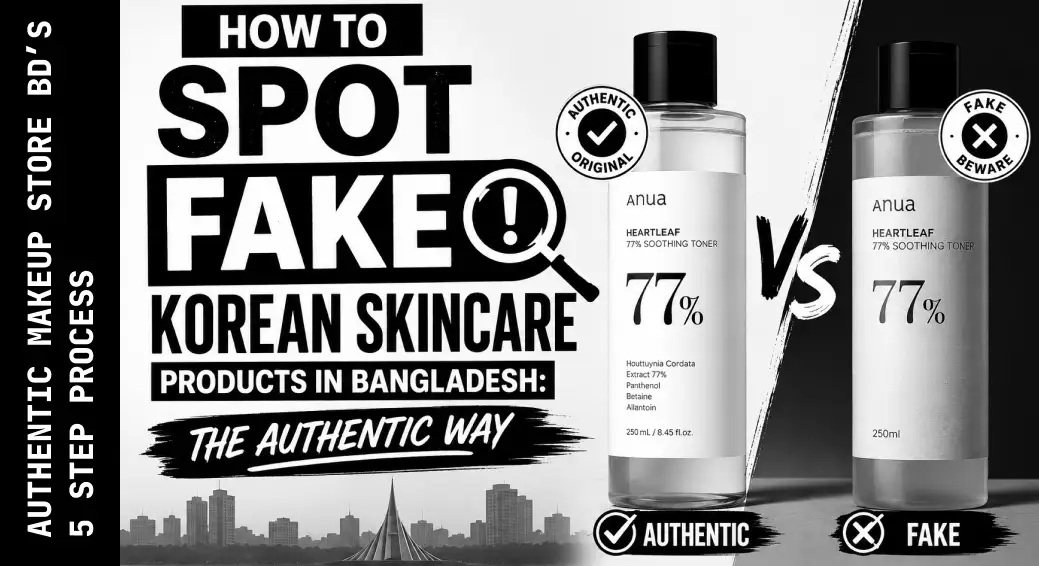
Fake Korean Skincare products are everywhere in Bangladesh. Some fake products look so good in photos that they can easily fool you.
But you can spot most fake products before you pay. You just need to check three things.
You can spot fake Korean skincare products by checking these three things:
First, the batch code. It should scan and show a real Korean manufacturing date. Second, the price. A sunscreen that sells for 1,500 taka but shows up at 600 is a fake. Third, the seller. Most fakes in Dhaka come from random Facebook preorder pages and unverified Daraz sellers.
That covers most cases. The rest of this guide is the detail.
Here is the good news. Counterfeit Korean skincare product almost always slip up somewhere. Maybe the printing looks off. Maybe the texture feels too thin or too thick. Or the code on the box does not match the bottle.
We catch these things every day at Authentic Makeup Store BD. We check each product before it reaches the shelf. You can run the very same checks at home. Just do it before your money leaves your bKash.
Authentic Makeup Store BD’s pre-purchase authenticity checklist for buyers
You do not need to memorize this whole guide. Save this checklist instead. Run it before every Korean skincare purchase. If a product fails two or more lines, walk away.
| Check | What you want to see | Red flag |
| Seller | Specialist store, real contact info | New account, no address |
| Price | Close to the normal market rate | Far too cheap to be real |
| Barcode | Starts with 880 for Korea | Missing or wrong prefix |
| Batch code | Matches on box and bottle, verifies online | No code, or fails the check |
| Manufacturing date | Clean YYYYMMDD format | Missing, vague or smudged |
| Packaging | Sharp printing, solid material | Blurry text, flimsy feel |
| Hologram or seal | Shifts color when tilted | Flat printed sticker |
| Korean text | Clean, correct spelling | Misspelled or blurry |
| Formula | Right texture, smell and color | Off smell, wrong feel |
| Reviews | Recent, with real photos | Few reviews, or fake spam |
Why is fake Korean skincare so common in Bangladesh?
The short answer is product demand. The demand for Korean skincare is so high that the authentic/official supply cannot keep up with it.
Think about how fast this happened. K-drama, K-pop and skincare TikTok made these brands huge here. COSRX, Beauty of Joseon, Anua and Skin1004 landed on every girl’s wishlist. But real supply could not keep up. Sellers imported whatever they could find. And some of it was never authentic Korean products.
That is because counterfeiters chase the best-sellers. The cheaper and more viral a product is, the more copies exist. Take the genuine Beauty of Joseon Relief Sun Aqua-fresh, for example. Or the COSRX snail mucin essence. People order these without a second thought. That is what makes them easy targets.
Now, how do these fakes actually reach you? In Bangladesh, they travel a few familiar routes.
The biggest one is Daraz. Watch new third-party accounts that price far below everyone else. Next come the Facebook and Instagram preorder pages. They promise stock from Korea, but they cannot show one real import paper. Then there are the New Market and Gausia stalls. Here, real and নকল sit on the same shelf, and nobody checks.
In-House Skincare Team of Authentic Makeup Store BD
This does not mean every cheap seller is a scam. But the checking still falls on you. Once the parcel arrives cash-on-delivery, a refund is hard to get.
What does fake Korean skincare do to your skin?
Fake skincare often contains toxic ingredients that can completely ruin your skin. A counterfeiter copies the box, not the formula. The real product passed safety testing under Korea’s Ministry of Food and Drug Safety (MFDS). The fake product passed nothing.
Here is what a fake Korean skincare product can do:
- Irritation and redness: Some fakes sting and turn skin red within a day.
- Sudden breakouts: Harsh, unknown fillers clog pores fast.
- Allergic reactions: Contact dermatitis is common with untested formulas.
- Barrier damage: Contamination can break down your skin’s defenses.
- Nothing at all: Some fakes are just scented water. You pay for filler that does nothing.
And Dhaka heat and sweat only make a reaction flare faster.
Think about the repair, not just the purchase. A damaged barrier takes weeks to heal. A good dermatologist in Dhaka is not cheap or quick to see. That is why prevention beats repair every time.
Important Note: One habit can save your skin. Patch test every new product first. Put a little on your inner arm. Then wait a day or two. Stop the moment your skin stings, burns or itches.
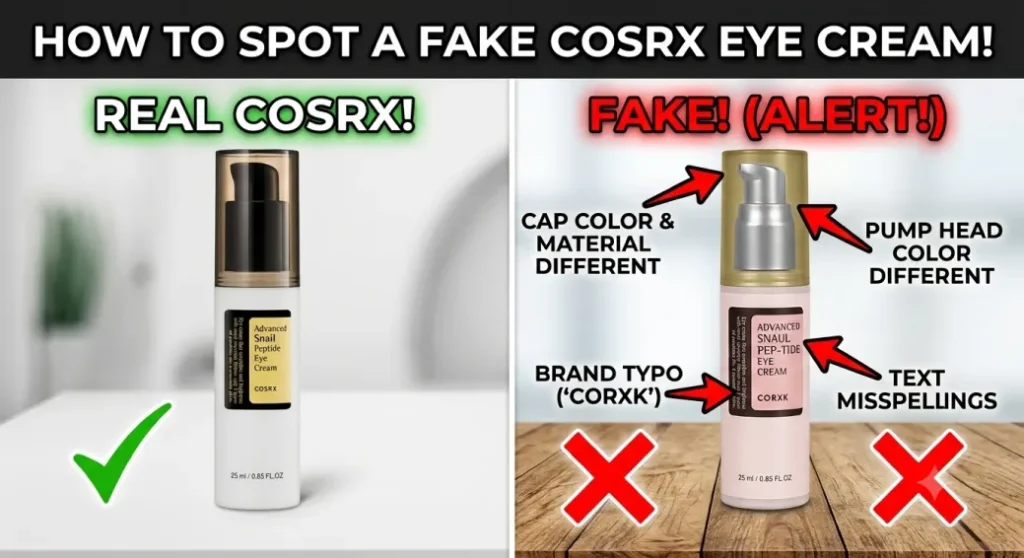
How We Spot Fake Korean Skincare: Authentic Makeup Store BD’s 5-Step Process
Step 1: Check the seller before you buy
The seller matters more than anything else. Check them first.
Your first job is to learn how to differentiate between a fake seller and a genuine seller.
Here is the hard part. A real product can turn fake in the wrong hands. Counterfeiters need somewhere to sell, and open marketplaces give them the perfect spot.
Look for these green flags:
- A real address and phone number: You can call them, and they pick up.
- An active page with honest reviews: Look for photos and dates, not five-star spam.
- A clear return or replacement policy: Good sellers tell you what happens if something is wrong.
- Open sourcing: The best stores say where their stock comes from.
Now flip it around and watch for red flags:
- A brand-new Daraz account with rock-bottom prices.
- A Facebook preorder page that cannot show one import paper.
- A seller who dodges a simple question like “is this from an authorized importer?”
Daraz needs its own warning. The platform lists official stores and third-party sellers on the same page. Read the seller name, not just the product. A brand store or a known retailer is safe. A random seller with ten reviews is a gamble.
Cash-on-delivery also tricks people. It feels safe, but it gives you no real protection. You pay before you ever test the product. Once the cash leaves your hand, the seller has won. Inspect the parcel at the door if your courier allows it. Check the seal and the price before you pay.
Even a trusted-looking seller can slip up. Next, turn to the product itself. Start with the packaging.
Step 2: Check the packaging
Real Korean packaging looks clean and sharp. Fakes get the small details wrong. Hold the box and bottle close, and look hard.
Run through this quick checklist:
- Logo: It should sit centered, sharp and straight. Fakes print it off-center or crooked.
- Font and color: Both should match the brand’s official site. Odd shades or mixed fonts are a bad sign.
- Printing quality: Real text is crisp. Blurry or smudged ink means trouble.
- Material: Genuine packaging feels solid. Flimsy, cheap plastic does not.
- Two-language ingredient list: Real exports print ingredients in Korean and English. English-only or vague wording like “natural extract” is a warning.
- Korean text: It prints clean on a real product. Misspelled or blurry text is a fake tell.
- Batch code: The code on the box must match the code on the bottle.
- Seal and hologram: A real hologram shifts color when you tilt it. A flat printed sticker does not.
This is the exact list our team uses. Before we list any Korean cleanser at Authentic Makeup Store BD, we check five things:
- The batch code on the box matches the code on the bottle.
- The barcode scans to the real Korean product, not a blank entry.
- The hologram shifts color at an angle, not a flat printed copy.
- The Korean text and ingredient list print clean, not blurry or misspelled.
- The texture and scent match the genuine product our team knows from stock.
One fair warning. Brands do update their packaging sometimes. A new look is not always a fake. We cover that difference in a later section, so do not panic over a fresh design just yet.
Step 3: Check the Bar-code, batch code and dates
Now go deeper than the packaging. The codes on the box tell a story, and fakes often get that story wrong.
Start with the barcode. A product made in South Korea has a barcode that begins with 880, Korea’s official GS1 country code. A missing or wrong prefix is a small warning sign. But do not trust the barcode alone. Counterfeiters copy those numbers too, so treat it as one clue, not proof.
The batch code is far more useful. Every real Korean product carries one. It is short, printed or laser-etched, never a cheap stuck-on sticker. Better yet, you can verify it online in under a minute.
Here is how:
- Most brands: CheckFresh.com. Type the brand and batch code. A real product returns a manufacturing date.
- COSRX: official.cosrx.com. Enter the batch number and expiry date from the pack.
- No result is a red flag. An error or blank means stop and question the product.
One honest catch. A valid code does not prove the product is real on its own. COSRX says this plainly. The code only counts when you also buy from a trusted seller. Pair the code check with the seller check from earlier.
Next, find the manufacturing date. Korean brands usually print the make date, not just the expiry, written as YYYYMMDD. So 20250612 means 12 June 2025. That format itself signals a genuine product.
Then think about shelf life. Unopened, most Korean skincare lasts about 36 months, roughly three years. Once opened, use it within 12 months. Look for the open-jar PAO symbol with a number like “12M.”
This matters more in our weather. Dhaka heat speeds up how fast a product turns. Check the date before you buy, and store it cool at home.
One last look: the origin line. A real product says “Made in Korea” in clean print. Vague, missing, or misspelled origin text is a problem.
But codes and dates only go so far. Some clever fakes pass every printed check. The next test is the product itself, scanned with an app and felt with your hands.
Step 4: Verify with QR Codes and Smart Labels
Sometimes, yes. Many Korean brands now add a QR code or a smart label. This can be a fast way to verify a product. But it is not foolproof, and you need to know the limits.
The most trusted tool is the HiddenTag app. Here is how it works:
- You find the HiddenTag smart label on the box.
- You scan it with the free app.
- The app tells you if the product is real in seconds.
But one rule decides everything. Not every brand uses HiddenTag. If your product has no smart label, the app cannot help. A missing label does not always mean a fake. It just means you fall back on the other checks.
Now for a big warning that most guides get wrong. Do not blindly trust a QR code.
Beauty of Joseon is the clear example. The brand is phasing out its QR-code and app check. Worse, counterfeiters already copied that QR. The fake codes once led to a dead AliExpress page. A working QR is not proof, and a brand dropping QR is normal, not suspicious.
Treat scanning as one layer, never the whole answer. Pair it with the seller, the batch code and the formula. That combination is what catches a smart fake.
Speaking of the formula, that is your next test. Once the product is in your hands, your senses take over.
Step 5: Check the formula itself
A counterfeiter can fake a box. Faking the formula is much harder. Your eyes, nose and fingers are powerful tools here.
Test a small amount on your hand first. Then judge it on four things:
- Texture: Each product has a signature feel. A COSRX Low pH Good Morning Gel should feel like a light gel, not a thick paste. A Skin1004 Hyalu-Cica Water-Fit Sun Serum should feel watery and thin, not heavy.
- Smell: Most Korean skincare has a faint, clean scent. A strong chemical or sour smell is a warning.
- Color: Compare it to the brand’s photos. A wrong shade points to a wrong formula.
- Absorption: Real K-beauty sinks in fast. A fake that sits sticky on top is a bad sign.
Then end with a patch test. Wait a day before it touches your face.
Here is a Dhaka twist most people miss. A real product can also feel slightly off. The reason is heat, not fakery.
Think about the trip your parcel takes. It bakes in a hot courier van. Then it sits through load-shedding before you open it. A genuine sunscreen can smell faint or feel a touch different after that ride. That is heat stress, not a counterfeit.
How do you tell them apart? Check the box first. If the seller is trusted, the batch code checks out, and the seal is intact, trust the product. A small heat change is normal here. A failed batch code plus a cheap price is not.
How to know between real reformulation and fake reformulation?
You go straight to the source. Open the brand’s official website or verified Instagram. Then compare your product to their newest photos. A real update will match what the brand shows.
This is a problem that trips up smart shoppers. Sometimes your product looks different, but it is still real. Korean brands change their packaging and formulas often. A new look is not always a fake.
This happens for normal reasons:
- Rebranding: A brand updates its logo or box design. Purito became Purito Seoul, for example.
- Reformulation: A brand improves the formula. The texture, smell or color shifts a little.
- New packaging: The same product arrives in a fresh bottle or tube.
- Limited editions: Special versions look different on purpose.
But stay alert to timing. New versions reach Bangladesh slowly. Two versions of the same product can sell here at once. That is confusing, but it is not always a scam.
When in doubt, just ask the seller. A trusted store will explain a rebrand without dodging. A vague or annoyed answer tells you plenty.
That said, some changes are not updates at all. They are pure red flags. Let us put them all in one place.
The red flags that usually mean a fake Korean skincare product:
You do not need every check to catch a fake. Often, one big red flag is enough. Keep this list in your head before you pay.
Walk away when you see these:
- A price too good to be true: A real 1,500 taka product at 600 taka is the oldest trap.
- No batch code, or one that fails the check: This is one of the strongest signs.
- Blurry printing or misspelled text: Real brands run tight quality control.
- A flat, printed “hologram.”: A real one shifts color when you tilt it.
- No manufacturer or origin info: “Made in Korea” should be clear, not missing.
- A seller who hides: No address, no phone, no straight answers.
- A code that does not match: The box and bottle must show the same batch code.
- A brand-new account with huge discounts: Especially on Daraz or a fresh Facebook page.
One flag means slow down. Two or more means stop. Trust the pattern, not the seller’s promises.
You now know how to catch a fake. But catching one is only half the job. The smarter goal is to never buy one at all. Next, let us talk about buying with confidence.
How to buy authentic Korean skincare in Bangladesh?
The best way to spot a fake is to never buy one. Shift your energy to the front end. Buy smart, and you skip the whole problem.
Follow these habits every time:
- Buy from a specialist, not a random seller: A reputed K-beauty products seller stakes its name on real stock.
- Choose direct importers: The fewer hands your product passes through, the safer it is.
- Check for authorized sourcing: Good stores tell you where their products come from.
- Read recent reviews with photos: Real buyers post real pictures.
- Confirm they answer questions: A seller who replies fast has nothing to hide.
Storage matters too, and most sellers ignore it. Korean skincare hates heat. A careless seller can ruin a real product before it reaches you. The right store keeps stock cool and away from direct sun. That is a quiet sign of a serious seller.
This is why we built Authentic Makeup Store BD around one promise. We source genuine products and check each one before it ships. Our tagline says it plainly. Say no to replica.
Want a safe start? Shop our verified Korean skincare range. Every product clears the same checks you just read about.
Buy from our 100% Authentic Korean Skincare Collection at the best price!
Still, mistakes happen to careful people. What do you do if a fake slips through?
Conclusion : What to do if you bought a fake Korean skincare product?
First, do not panic. But do act fast. The right steps protect your skin and your money.
Move through them in order:
- Stop using it now: Do not give a fake another chance to harm your skin.
- Take photos of everything: Capture the box, the bottle, the batch code and the seller chat.
- Contact the seller: Ask for a refund or replacement, and keep the messages.
- Report the listing: Flag it on Daraz, Facebook or wherever you bought it.
- Tell the brand: Send the brand your photos and the seller’s name.
Now for the honest part about money. In Bangladesh, recovery is hard. Cash-on-delivery and bKash give you no chargeback. You cannot reverse the payment like a card user abroad. A good seller may still refund you. A scam seller will vanish.
This is the real lesson. Your protection lives in prevention, not the refund. The checks in this guide are your true safety net. Use them before you pay, every single time.
And if your skin reacted badly, watch it closely. Most irritation calms down once you stop the product. But see a dermatologist if the redness, burning or breakout does not settle. Your skin is worth that visit.

Skincare Expert